What Is Mobile Cardiac Imaging?
Mobile cardiac imaging is a service model where a fully credentialed cardiac PET/CT, mobile cardiac SPECT, or cardiac ultrasound system is delivered directly to a cardiology practice on scheduled days, allowing the practice to perform advanced cardiac scans in-house without building a fixed nuclear lab. The clinically dominant version in 2026 is mobile cardiac PET/CT (often called a cardiac PET scan, PET heart scan, or PET stress test for heart), which the ASNC, SNMMI, and SCCT joint guidelines now position as the most accurate non-invasive test for coronary artery disease.
Five things to know about mobile cardiac imaging in 30 seconds:
- What it is: A complete cardiac imaging system — scanner, technologists, Rubidium-82 isotopes, and reading software — brought to your office on a scheduled day. Sometimes called mobile molecular imaging or mobile nuclear medicine.
- Why it matters in 2026: ASNC's January 2026 clinical guidance update positions cardiac PET as the preferred test for evaluating coronary artery disease — no longer CTA-first.
- Who it's for: Cardiology practices that currently refer cardiac scans out, run SPECT but want PET-grade accuracy, or want to capture imaging revenue without a $2M+ lab build.
- The economics: A cardiac PET scan reimburses approximately 5.4 times the rate of SPECT at 100 percent Medicare ($3,246 vs $600 per patient). One PET day per week can generate $621K in Year 1 revenue.
- The clinical edge: Cardiac PET delivers 88 to 91 percent diagnostic accuracy versus approximately 70 percent for SPECT, with a 45-minute exam (vs 3 to 4 hours for SPECT) and the only modality that quantifies real myocardial blood flow.
If you are a cardiologist, practice administrator, or hospital service-line leader evaluating mobile cardiac imaging, the rest of this guide walks through every modality, what a cardiac PET scan shows, who qualifies, the financial case, vendor evaluation criteria, and how VIP Imaging — Southern California's largest mobile cardiac PET/CT provider — has helped hundreds of practices bring cardiac PET in-house since 2008.
Why Mobile Cardiac Imaging Matters More in 2026
The clinical and financial case for mobile cardiac imaging shifted significantly in the last 18 months. Three forces collided.
- ASNC moved cardiac PET to first-line. In January 2026, the American Society of Nuclear Cardiology updated its clinical guidance to position cardiac PET — not coronary CT angiography (CCTA) — as the preferred non-invasive test for evaluating known or suspected coronary artery disease where both modalities are appropriate. PET's combination of higher specificity, absolute myocardial blood flow quantification, and lower radiation than SPECT made it the more accurate cardiac scan.
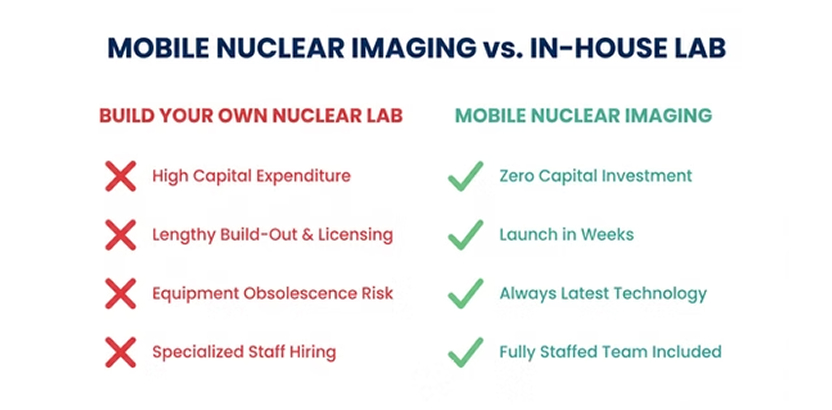
- The capital wall is gone. A fixed cardiac PET lab requires roughly $2 million in equipment, lead-shielded build-out, dedicated nuclear staff, and 12 to 18 months of credentialing. A mobile PET/CT model collapses that to a recurring service contract with no capital expense, no construction, and a launch timeline measured in weeks.
- Patient retention became a margin question. When a cardiology practice refers a patient out for a cardiac PET scan or stress test, the imaging revenue, follow-up office visit, and a meaningful share of the longitudinal care relationship leave the practice. With Medicare reimbursement compressing on cognitive codes, capturing the imaging study in-house has become the single largest revenue-recovery move available to most practices.
- The reimbursement gap widened. At 100 percent Medicare, a single cardiac PET/CT study reimburses approximately $3,246, compared to $600 for a comparable SPECT study — a 5.41 times difference per patient. Over a typical 1-day-per-week, 48-week mobile PET schedule, that compounds to $621K in Year 1 and $8.46M over three years at modest volume growth.
-
What Is a Cardiac PET Scan?
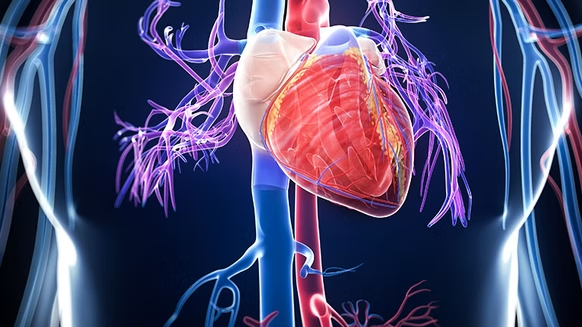
A cardiac PET scan — also called a PET heart scan, PET scan of the heart, or PET test for heart — is a positron emission tomography study of myocardial perfusion. The scan uses a radioactive perfusion tracer (most commonly Rubidium-82, sometimes N-13 ammonia) injected intravenously at rest and again under pharmacologic stress. The PET scanner detects the tracer's emissions and reconstructs detailed images of how blood flows to the heart muscle.
A cardiac PET scan answers questions that no other non-invasive test can answer with equivalent accuracy: how much blood is reaching the heart muscle, whether there is balanced ischemia (multi-vessel disease), and whether myocardium is viable or scarred. When the cardiac PET is paired with a low-dose CT in the same gantry — a cardiac PET/CT — the CT also delivers attenuation correction and a coronary calcium score in the same 45-minute appointment.
A cardiac PET scan visualizes myocardial perfusion at rest and under stress, absolute myocardial blood flow in mL/min/g, coronary flow reserve (CFR), ischemia (reversible perfusion defects), infarction or scar (fixed defects), and — with the integrated CT — a coronary calcium score. Cardiac PET scans pick up balanced ischemia and microvascular disease that SPECT consistently misses, which is one reason they outperform SPECT in real-world diagnostic accuracy.
The Four Modalities Used in Mobile Cardiac Imaging
Not every mobile cardiac imaging provider offers the same thing. Here are the four modalities you will encounter.
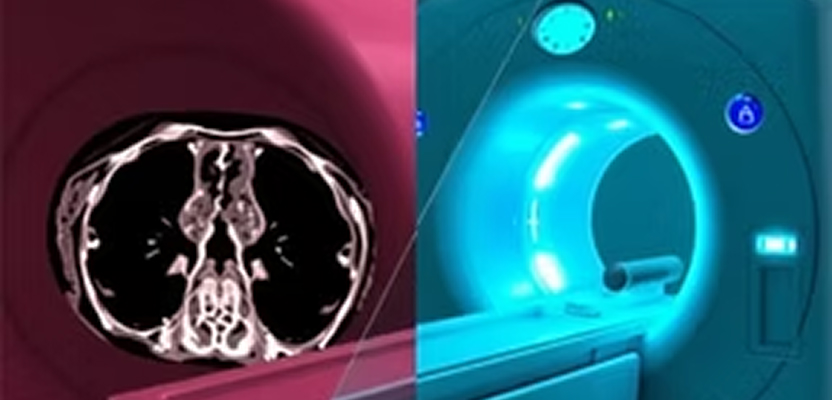
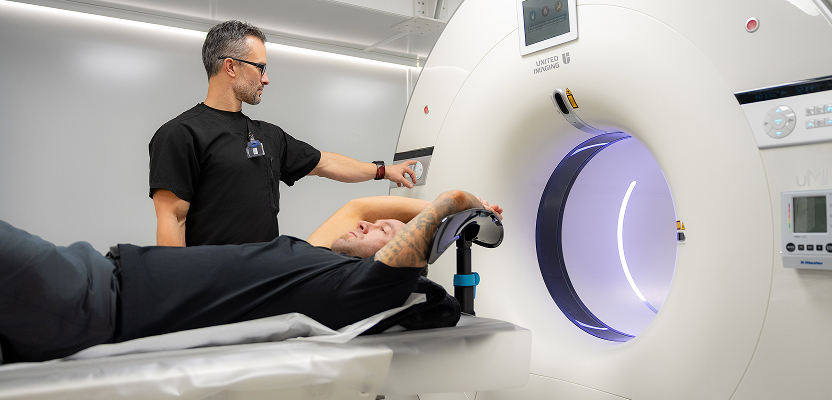
Mobile Cardiac PET/CT — the new standard. A combined positron emission tomography and computed tomography scanner using Rubidium-82 (Rb-82) or N-13 ammonia as the perfusion tracer. Modern mobile PET/CT scanners — such as the United Imaging UMI 550, an 80-slice digital system released in 2025 — produce diagnostic-grade images, quantify absolute myocardial blood flow, and complete a full rest/stress study in approximately 45 minutes.
Mobile Cardiac SPECT - Single-photon emission computed tomography — sometimes searched as SPECT heart scan — is the older nuclear cardiology workhorse. A SPECT myocardial perfusion study takes 3 to 4 hours, has lower diagnostic accuracy (around 70 to 88 percent sensitivity, 74 to 85 percent specificity), and cannot quantify absolute blood flow.
Many mobile cardiac imaging providers still offer mobile SPECT, but the clinical and reimbursement case has moved decisively toward PET.
Mobile Cardiac Ultrasound (Echo). Mobile echocardiography services bring an experienced sonographer and a portable ultrasound to the practice for transthoracic echos, stress echos, vascular studies (carotids, aorta, arterial, venous), and cardiac structural evaluation. Mobile echo answers structural and functional questions (valvular disease, EF, wall motion) but does not detect ischemia or perfusion abnormalities.
Mobile Cardiac MRI. Less common as a true mobile service due to magnet logistics, mobile cardiac MRI exists at the high end and is offered by a small number of large fleet operators. Cardiac MR is excellent for tissue characterization (fibrosis, edema, infiltration) but is rarely the right fit for a community cardiology practice's mobile day.
For most practices considering mobile cardiac imaging in 2026, the practical decision is between mobile PET/CT (highest-accuracy, highest-reimbursing perfusion modality) and mobile echo/ultrasound (lower per-study reimbursement but answers different clinical questions). The two are often run on different mobile days and complement each other.
Mobile Cardiac PET vs Mobile Cardiac SPECT: Side-by-Side
The single most important decision a practice makes when evaluating mobile cardiac imaging is whether to run cardiac PET, cardiac SPECT, or both.
- Diagnostic accuracy: SPECT delivers approximately 70 to 88 percent sensitivity and 74 to 85 percent specificity. Cardiac PET delivers 88 to 91 percent sensitivity and 86 to 90 percent specificity.
- Exam time: A SPECT heart scan takes 3 to 4 hours total. A cardiac PET stress test takes 45 minutes total.
- Tracer: SPECT uses Tc-99m sestamibi or tetrofosmin. Cardiac PET uses Rubidium-82 (an Rb-82 PET scan) or N-13 ammonia. The Rb-82 half-life is approximately 75 seconds, which is why PET delivers a much lower cumulative radiation dose than SPECT.
- Radiation dose: SPECT delivers approximately 12 mSv per typical study. Cardiac PET with Rb-82 delivers only 3 to 5 mSv.
- Absolute myocardial blood flow: Cardiac PET can quantify mL/min/g; SPECT cannot.
- Calcium score in same session: Cardiac PET/CT can capture it with the low-dose CT; SPECT cannot.
- Multi-vessel disease detection: Cardiac PET detects balanced ischemia; SPECT often misses it.
- Patients with BMI over 30: Cardiac PET maintains image quality; SPECT image quality degrades.
- Medicare reimbursement at 100 percent: Cardiac PET/CT reimburses approximately $3,246 per patient; SPECT approximately $600 — a 5.4 times difference.
- Capital required: A SPECT lab needs roughly $500K plus ongoing operational cost. Mobile PET requires $0 capital.
For most practices, the right answer is mobile cardiac PET/CT first, with SPECT retained for specific cases or specific payers. For complete code-by-code reimbursement detail, see our 2026 Cardiac PET/CT Reimbursement Guide. For the broader PET vs CT clinical comparison, see our PET Scan vs CT Scan guide.
Which Patients Qualify for a Cardiac PET Scan?
Cardiac PET has the same indications as SPECT — meaning any patient currently appropriate for a SPECT myocardial perfusion study is appropriate for a cardiac PET scan. PET is specifically preferred for patient populations where SPECT image quality or interpretation is compromised.
Patients who qualify for a mobile cardiac PET scan include:
- Coronary artery disease (CAD) and ischemia evaluation — the highest-volume indication.
- Chest pain that is undiagnosed.
- Abnormal EKG or abnormal stress test.
- Suspected microvascular disease (only PET quantifies flow reserve).
- Multi-vessel disease suspected — PET detects balanced ischemia; SPECT often does not.
- Obese patients (BMI greater than 30) — PET maintains image quality where SPECT degrades.
- Previous MI, prior stent, prior bypass surgery.
- Heart failure or cardiomyopathy evaluation.
- Pre-operative cardiac risk assessment.
- Patients unable to exercise (pharmacologic stress with regadenoson / Lexiscan).
- Previous false-positive or false-negative SPECT.
ASNC's clinical guidance is direct: do not save cardiac PET/CT for last as a tiebreaker test — use it as the first test in patients where it is appropriate. The accuracy gains are largest at the front of the diagnostic pathway.
How a Mobile Cardiac PET Day Actually Works
The operational concern most cardiology practices have about mobile cardiac imaging is workflow. Here is what a typical VIP Imaging mobile PET day looks like.
The trailer arrives the night before or early morning. A self-contained mobile cardiac PET/CT trailer parks in your lot, connects to power, and is ready before the first patient. The trailer houses the scanner, hot lab, control room, and patient prep area — essentially a full nuclear cardiology suite on wheels.
Patient flow runs on a 45-minute cycle:
- Arrival and prep (about 10 minutes): patient check-in, IV placement, baseline EKG.
- CT calcium scan (1 to 2 minutes): quick low-dose CT for coronary calcium and attenuation correction.
- Rest PET imaging (8 to 10 minutes): baseline myocardial perfusion at rest.
- Pharmacologic stress (3 to 4 minutes): regadenoson (Lexiscan) administered.
- Stress PET imaging (8 to 10 minutes): peak-stress perfusion imaging.
A typical mobile PET day runs 12 to 15 patients. The imaging team is fully self-contained — VIP technologists handle the scanning, radiotracer logistics, and quality control. Your staff sees the patient at check-in and again at discharge.
Reading and reporting is delivered within 12 hours via a cloud-based platform. VIP uses 4DM and Cedars-Sinai reading software. The formal radiology report is in the practice's hands the next morning — often before the patient's follow-up visit.
The Financial Case: How Mobile Cardiac PET/CT Pays for Itself
Most practices evaluating mobile cardiac imaging are doing so partly for clinical reasons and partly because the math is now overwhelming.
Per-patient revenue at 100 percent Medicare:
- Cardiac PET/CT (CPT 78431, 78434, 93015, A9555, J2785) reimburses approximately $3,246.
- Cardiac SPECT (CPT 78451 or 78452, 93016, A9500) reimburses approximately $600.
- Difference per patient: $2,646 — a 5.41 times multiple.
Program-level revenue (1 PET day per week, 48 weeks per year):
- Year 1 at approximately 12 patients per day: $621K annual cardiac PET revenue.
- Year 2 at 20 percent growth: $745K.
- Year 3 at 20 percent growth: $894K.
- Three-year cumulative: approximately $2.3M in cardiac PET revenue, or $8.46M when ancillary in-practice care is captured.
The mobile PET/CT model also avoids the capital costs of a fixed cardiac PET lab: no $2M+ equipment purchase, no lead-shielded room build, no dedicated nuclear medicine technologist hire, no quarterly RAM license inspection, no 12 to 18 month launch timeline. The practice pays a per-patient or per-day service fee to the mobile provider and keeps the difference between Medicare reimbursement and that fee.
How to Evaluate a Mobile Cardiac Imaging Partner
Not all mobile cardiac imaging providers are equal. Five questions separate strong vendors from weak ones.
Scanner age and configuration.
Cardiac PET imaging quality depends heavily on the scanner. Older 16-slice analog systems (some still in service from 2005) cannot deliver the spatial resolution, motion correction, or EKG gating of a modern digital system. Ask: what model, what year, analog or digital, how many CT slices? A modern unit such as the United Imaging UMI 550 is digital, 80-slice, with 2.9 mm spatial resolution, motion correction, and EKG gating. A legacy Siemens Biograph Horizon from 2005 is 16-slice analog with no motion correction.
Both are technically PET/CT — the diagnostic outputs are not the same.
Regulatory and compliance history.
Mobile imaging is heavily regulated. Ask: has the company been investigated, fined, or audited by the Department of Justice? Are physicians paid above fair market value? Are referrals tied to payments? Several mobile cardiac imaging providers have faced DOJ scrutiny for arrangements that violated Stark Law and the Anti-Kickback Statute. When a partner gets in regulatory trouble, every practice they served can become part of the audit. Search PACER and the OIG exclusion list before signing.
Reading software and turnaround SLA.
The scanner is half the equation. The other half is the reading platform. Ask: what reading platform? Cloud-based access? Read turnaround SLA? Industry-leading platforms include 4DM and Cedars-Sinai. Both are cloud-based and built for cardiac PET specifically. If a vendor uses an off-brand platform, ask why.
In-office concierge support.
The biggest single difference between mobile providers is whether the relationship ends at the trailer door or includes the operational support that makes the program run. A concierge model puts a trained operations person inside your practice on PET days — handling scheduling, prior authorizations, billing optimization, CPT coding, and patient eligibility. Practices working with a concierge typically see 25 to 50 percent higher imaging volume.
Trial day with no commitment.
A reputable mobile cardiac imaging partner should be willing to run a single trial day at your practice with no commitment. You see the workflow, equipment, staff, report quality, and reimbursement reality with your own patients. If a vendor will not do a trial day, that is a red flag.
The VIP Imaging Advantage
VIP Imaging is Southern California's largest mobile cardiac PET/CT provider, serving cardiology practices across Los Angeles, Orange County, San Bernardino, Riverside, San Diego, and the Coachella Valley. We have operated since 2008 — 18 years of mobile cardiac imaging experience — and both founders are still actively scanning patients and supporting practices.
Here is what differentiates VIP from generic mobile imaging:
- Modern equipment, not legacy. VIP runs the United Imaging UMI 550 — a 2025+ digital 80-slice PET/CT with 2.9 mm spatial resolution, motion correction, EKG gating, and a 551-lb table weight limit — versus competitors still operating 2005-era 16-slice analog Siemens Biograph Horizon systems.
- Industry-leading reading software. Every VIP cardiac PET scan is read in 4DM and Cedars-Sinai, the gold-standard reading platforms, cloud-based, with 12-hour turnaround.
- Real myocardial blood flow and calcium score. Not estimated from software — actually measured on each scan. This is one of the largest clinical gaps competitors miss.
- In-office VIP Concierge Service. A trained operations professional placed inside your practice on PET days, handling scheduling, prior-auth paperwork, billing accuracy, and real-time on-site support. Practices using the VIP concierge typically increase imaging volume by 25 to 50 percent.
- Clean compliance record. No DOJ investigations, no fines, no kickback investigations. Worth checking on every vendor you consider.
- Run by technologists. Both VIP owners came from the scanner side of the business and continue to scan patients. The company is built around clinical operations — not equipment leasing.
- Trial day, no commitment. Single-day trial at your practice. Tour the trailer, meet the team, see the reimbursement, evaluate the workflow.
If you would like to see how a VIP mobile cardiac PET program would look at your office, request a trial day or practice assessment. For service details, see our Mobile Cardiac PET/CT page.
Frequently Asked Questions
What is mobile cardiac imaging?
Mobile cardiac imaging is a service model in which a fully credentialed cardiac imaging system — most commonly cardiac PET/CT, but also SPECT or echocardiography — is delivered directly to a cardiology practice or hospital outpatient facility on scheduled days. The practice gains advanced cardiac scan capability without building a fixed nuclear lab.
What is a cardiac PET scan?
A cardiac PET scan (also called a PET heart scan, PET scan of the heart, or PET test for heart) is a positron emission tomography study of myocardial perfusion. A radioactive tracer — most commonly Rubidium-82 — is injected intravenously at rest and again under pharmacologic stress, and the PET scanner reconstructs detailed images of blood flow to the heart muscle. When paired with a low-dose CT, it is called a cardiac PET/CT and also produces a coronary calcium score.
What is the difference between mobile cardiac PET and mobile cardiac SPECT?
Cardiac PET delivers higher diagnostic accuracy (88 to 91 percent vs SPECT's 70 to 88 percent), a 45-minute exam vs 3 to 4 hours, lower radiation with Rb-82 (3 to 5 mSv vs 12 mSv for SPECT), and the ability to quantify absolute myocardial blood flow and coronary flow reserve. Cardiac PET also reimburses approximately 5.4 times more per patient at 100 percent Medicare. The 2026 ASNC guidance positions PET as the preferred non-invasive test for CAD evaluation.
How long does a cardiac PET scan take?
A complete rest/stress cardiac PET/CT exam takes approximately 45 minutes total, including the CT calcium scan, rest PET imaging, pharmacologic stress administration, and stress PET imaging. Compare that to 3 to 4 hours for a SPECT myocardial perfusion study.
What is an Rb-82 PET scan? What is the Rb-82 half-life?
An Rb-82 (Rubidium-82) PET scan is a cardiac PET study that uses Rubidium-82 as the perfusion tracer. The Rb-82 half-life is approximately 75 seconds, which is one reason PET delivers a much lower cumulative radiation dose than SPECT and why Rb-82 cardiac PET is the most common cardiac PET tracer used in mobile programs.
Is mobile cardiac PET reimbursed by Medicare?
Yes. Cardiac PET/CT is reimbursed under standard CPT codes (78431 for PET myocardial perfusion, 78434 for myocardial blood flow quantification, plus 93015 for the cardiovascular stress, A9555 for the Rb-82 radiopharmaceutical, and J2785 for regadenoson). At 100 percent Medicare, a complete cardiac PET/CT reimburses approximately $3,246, compared to $600 for a comparable SPECT study.
How much does a cardiac PET scan cost a practice?
Mobile cardiac PET is delivered as a service — there is no capital cost for the practice. The mobile provider charges either a per-patient or per-day fee, and the practice retains the difference between Medicare or insurance reimbursement and the service fee. Practices typically net several thousand dollars per patient after the service fee.
Is mobile cardiac PET safe?
Yes. Mobile cardiac PET delivers a lower radiation dose than SPECT when using Rb-82, because Rb-82 has a 75-second half-life and the patient receives a much smaller cumulative dose. The American Cancer Society notes the average background radiation a person is exposed to per year is approximately 3 mSv, so a single Rb-82 cardiac PET exam (3 to 5 mSv) delivers roughly the equivalent of one year of background radiation. Cardiac PET has no contrast-related allergy risk and no kidney clearance considerations.
Are there mobile cardiac PET providers in Los Angeles or Southern California?
Yes. VIP Imaging is the largest mobile cardiac PET/CT provider in Southern California — serving Los Angeles, Orange County, San Bernardino, Riverside, San Diego, and the Coachella Valley. Practices searching pet/ct los angeles, pet scan los angeles, or cardiac scans near me who want a mobile, in-office program should request a trial day.
Trial Day: How to Evaluate Mobile Cardiac Imaging at Your Practice
If you would like to see how mobile cardiac imaging actually works at your practice without committing to a recurring schedule, the standard first step is a trial day.
A VIP Imaging trial day includes:
- No commitment — single day, no recurring contract.
- The mobile PET/CT trailer at your office for the full day.
- A reimbursement projection specific to your practice, based on your patient mix and payer breakdown.
- A live tour of the scanner and reading platform.
- Pre-scheduled patient slots to actually run scans during the trial.
- A debrief at the end of the day covering clinical impact, financial opportunity, and a recommended go-live timeline.
Request a trial day or practice assessment from VIP Imaging.
Sources
- American Society of Nuclear Cardiology. Clinical Guidelines.
- Society of Nuclear Medicine and Molecular Imaging / ASNC / SCCT. Joint Guideline for Cardiac SPECT/CT and PET/CT 1.0.
- American Heart Association — Circulation: Cardiovascular Imaging. Diagnostic Accuracy of Cardiac PET vs. SPECT for Coronary Artery Disease.
- American College of Cardiology. ASNC Imaging Guidelines.
- RadiologyInfo.org (RSNA & ACR). Cardiac Nuclear Medicine.
- American Cancer Society. Understanding Radiation Risk from Imaging Tests.
- National Center for Biotechnology Information (NCBI / StatPearls). Cardiac Positron Emission Tomography.
- Centers for Medicare & Medicaid Services. Physician Fee Schedule Lookup Tool.